AI Service Business SEO Playbook
The AI-First Authority Framework™ for Local Service Companies
21 chapters across 5 interconnected parts. Proprietary frameworks you won't find anywhere else. A 90-day roadmap that turns knowledge into results. Built for plumbers, HVAC techs, electricians, roofers, and every service business in between.
Three Reading Paths — Start Where You Are
The playbook adapts to your experience level. Choose the path that matches your starting point.
New to Local SEO
Start with Part I and work through each chapter in sequence. Complete the Execution Layer™ checklist before moving forward.
Priority: Ch. 1, 2, 3, 4, 8, 11, 19
Done Some SEO Before
You have a website and GBP. Jump to the chapters that address your weakest areas and use the 90-Day Launch as your spine.
Priority: Ch. 4, 6, 11, 12, 16, 21
Agency / Professional
You know SEO fundamentals. Grab the proprietary frameworks, adapt the Prompt Library for clients, and use the case studies for benchmarks.
Priority: Ch. 4, 7, 12, 17, 21
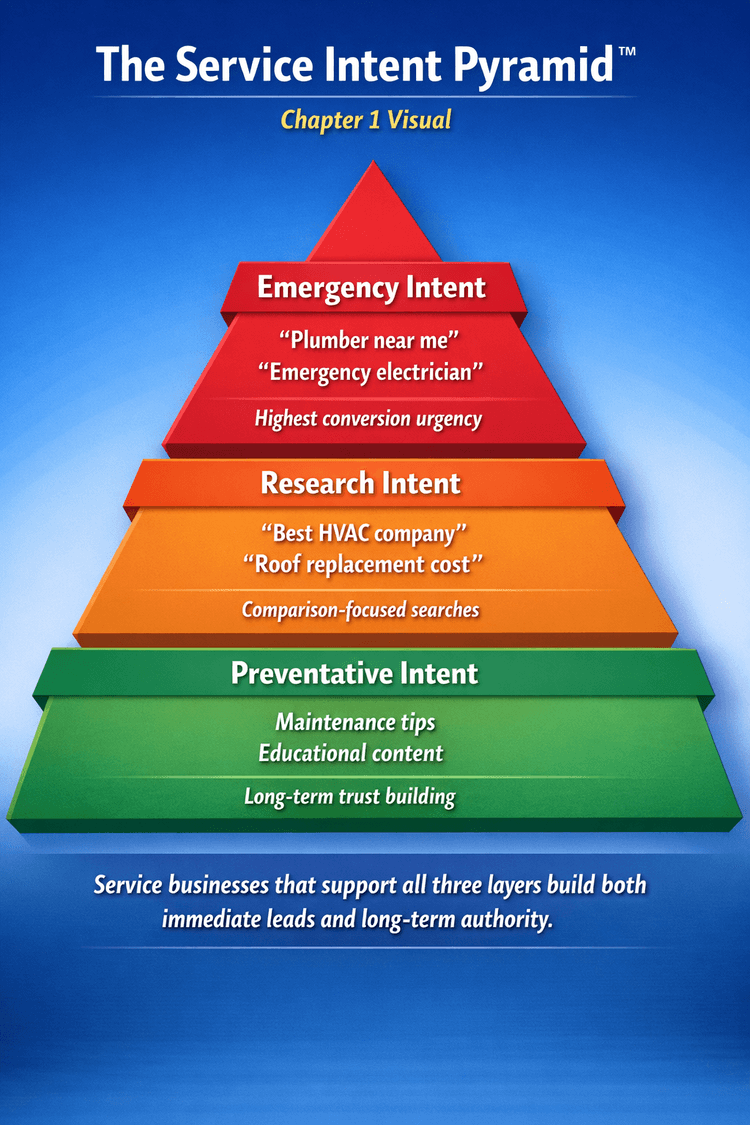
The Service Intent Pyramid™
Every chapter in this playbook connects back to a core truth: customers search with intent. Understanding and mapping that intent is the foundation of everything that follows.
Emergency intent drives immediate calls. Research intent builds comparison traffic. Preventative intent creates long-term trust. The playbook shows you how to capture all three.
The AI-First Authority Framework™
Before diving into tactics, every chapter connects back to four interconnected pillars that create a compounding growth engine:
Service Intent Authority Model™
Understanding how customers search — from emergency decisions to long-term research.
Service Authority Stack™
Structuring your website so every page reinforces expertise instead of competing for attention.
Local Map Pack Domination Framework™
Strengthening the signals that influence local visibility, engagement, and trust.
Execution Layer™
Turning strategy into consistent weekly actions that compound authority over time.
Together, these pillars create an ecosystem where clarity leads to visibility — and visibility leads to growth.
Inside the Playbook
The Service Intent Authority Model™
Before optimizing pages or creating content, understand why customers search. Service businesses operate in a unique environment where urgency and research intersect.
The Service Intent Pyramid™ organizes intent into three layers: Emergency ("plumber near me" — highest conversion), Research ("best HVAC company in [city]" — comparison-focused), and Preventative ("maintenance tips" — long-term trust building). Most businesses over-invest in emergency content and neglect the other two. Covering all three layers builds topical authority[21], earns AI citations, and supports customers at every stage of their decision.
Key Takeaway
Organize your entire content strategy around how people actually search — not just keywords.
The Service Authority Stack™
Many service websites grow randomly, creating disconnected pages that fail to build authority. The Service Authority Stack™ organizes content into a five-layer pyramid.
The stack includes Authority Content, Problem Pages, Service Pages, Location Pages, and Google Business Profile — each layer reinforcing the next. Most businesses lack the top two layers (authority content and problem pages). Building internal pathways between layers[23] creates a cohesive ecosystem that search engines and AI systems interpret as genuine expertise.
Key Takeaway
Every page on your site should strengthen the pages around it — not exist in isolation.
The Technical Foundation Layer™
Every strategy in this playbook depends on a technical foundation that allows search engines and AI systems to access, crawl, and interpret your content efficiently.
Covers Core Web Vitals (LCP, INP, CLS)[1], mobile-first indexing[2], crawl efficiency (XML sitemaps[3], robots.txt, canonical tags[4]), and Google Search Console[19] essentials. For most local service businesses, getting the technical foundation right puts you ahead of the vast majority of competitors.
Key Takeaway
You can't build authority on a broken foundation. Fix the technical layer first.
The AI Citation & Answer Engine Method™
Customers are asking AI assistants and relying on AI-generated summaries to guide their decisions. The businesses whose content gets selected as a source gain a visibility advantage that traditional rankings cannot match.
Covers how AI systems select sources through entity clarity, direct answer density, structured predictability, and freshness. Introduces the Citation-Worthy Paragraph Method™ — self-contained 40–60 word blocks designed to be cited by ChatGPT, Gemini, and AI Overviews[22]. The single most powerful content unit for AI visibility.
Key Takeaway
AI does not rank pages. It cites answers. Structure your content to be the answer.
The Semantic Optimization Blueprint™
Modern search engines evaluate meaning — the relationships between topics, questions, and solutions. Service businesses naturally deal with interconnected problems.
Build topic pathways that connect services to problems to locations (e.g., Water Heater Leak → Emergency Plumbing → Phoenix Service Area). The Cluster Expansion Method builds authority in three phases: Core Foundation, Cluster Bridges, and Semantic Depth Layers. Natural language that reads like genuine expertise performs better in both search and AI results[26].
Key Takeaway
Build meaning-based connections between your content, not just keyword density.
The Voice Search Authority System™
Customers standing in a flooded kitchen don't sit down at a computer — they say "Hey Google, I need an emergency plumber near me right now." Voice queries are longer, conversational, and local.
FAQ questions should mirror natural spoken language. Featured snippet formatting[5] (question heading → concise answer → supporting detail) positions your content for voice selection. Speakable schema markup[6] tells search engines which sections are voice-ready. Test your own services by voice regularly — the results reveal exactly where to improve.
Key Takeaway
Voice search rewards the clearest, most direct answer. Be that answer.
The Machine Understanding Layer™
Schema markup[11] acts as a bilingual translator between your content and machine systems. Most service businesses overlook this entirely — creating a major competitive advantage for those who implement it.
Implementation hierarchy: LocalBusiness[7] first, FAQPage[8] second, Service[9] third, then supporting types. FAQPage schema on service pages is the most direct path to AI citation eligibility. Schema must match visible page content and GBP data exactly. Validate with Google's Rich Results Test[10] and maintain quarterly.
Key Takeaway
Schema markup is the competitive advantage hiding in plain sight.
The E-E-A-T Authority Blueprint™
Google evaluates content through Experience, Expertise, Authoritativeness, and Trustworthiness[12]. For service businesses, E-E-A-T is a direct reflection of what makes customers choose you.
First-person experience signals are the hardest for competitors to replicate. Short case studies demonstrate experience more effectively than general content. AI-generated content must be layered with real-world observations to meet E-E-A-T standards[13]. Every page on your website either strengthens or weakens these signals.
Key Takeaway
E-E-A-T is not a ranking factor you optimize — it's a reputation you build.
The Proof Layer™
Before a customer calls, they ask one silent question: "Can I trust this company?" The Proof Layer™ answers that question before it is ever spoken aloud.
Proof placement matters as much as proof existence — embed it throughout service pages. The Proof Collection System (60-second job photos, 4-hour review requests[25], monthly proof features) transforms proof-building from a wish into a habit. Proof signals increasingly influence AI citation decisions[22].
Key Takeaway
Show your work. Visible proof converts visitors into customers.
The Video Authority Engine™
Video is no longer optional. A 60-second job walkthrough recorded on a smartphone builds more trust than any written description. Authenticity outperforms polish.
Four content types work best: job walkthroughs, FAQ answers, process explainers, and seasonal tips. Every video should live on YouTube and your website. YouTube optimization requires location-specific titles and 200-word descriptions. VideoObject schema[14] increases rich result eligibility.
Key Takeaway
One authentic job video builds more trust than a dozen stock photo pages.
The Local Authority Engine™ & Advanced GBP Mastery
Your Google Business Profile is often your first customer interaction. It is not a passive listing — it is an active authority signal that compounds with consistent engagement.
The three local ranking factors are Relevance, Distance, and Prominence[15] — you control two of them. Primary category selection[18] has an outsized impact on visibility. The Review Velocity System™ (request within 24 hours, respond to 100%)[16] builds social proof systematically. Weekly GBP activity is the single most consistent differentiator between businesses that dominate the Map Pack and those that don't.
Key Takeaway
Your GBP is not a set-it-and-forget-it listing — it's a living authority engine.
The Local Map Pack Domination Framework™
For many service businesses, the Map Pack generates more calls than traditional organic rankings. Dominating it requires structured signals working together.
Map Pack dominance requires signals across four categories[17]: on-site authority, off-site signals, behavioral engagement, and review velocity. No single action guarantees top-three placement — it is the combination that creates dominance. The business that strengthens the most dimensions wins.
Key Takeaway
The Map Pack is where calls come from. Dominating it is non-negotiable.
The Citation & Directory Authority System™
Before a customer finds your website, search engines have already evaluated how your business is represented across the broader internet.
NAP consistency (Name, Address, Phone) is the single most important citation factor[17]. Data aggregators distribute your information to hundreds of platforms — ensure accuracy at the source. Industry-specific directories carry authority weight beyond general business listings. Unlinked brand mentions still contribute to authority.
Key Takeaway
Every consistent mention of your business across the web compounds your authority.
The Relationship Link Strategy™
The strongest backlinks come from genuine partnerships — not shortcuts. Search engines evaluate the credibility of linking sites. Quality over quantity, always.
Supplier partnerships, trade associations, podcast interviews, and community sponsorships are the four highest-value link categories for service businesses. Relationship-based links reflect genuine involvement in your community and industry — and align with Google's guidelines on earned links[24]. Ask "Who already trusts my business?" to identify your best opportunities.
Key Takeaway
Earn links through relationships, not link-building schemes.
The Service Area Expansion Model™
Most service businesses serve multiple areas but their websites fail to reflect this clearly. Location pages must feel genuinely local, not templated.
Localized service overviews, community context, local proof signals, and internal connections are the four essential elements. Start with your strongest service areas and add depth before breadth. Thin location pages that only swap city names are frequently filtered by Google[13].
Key Takeaway
Every city you serve deserves its own entry point — not a generic page.
The Experience Optimization Framework™
Traffic without conversion is wasted visibility. This chapter bridges the gap between being found and being hired.
Click-to-call buttons, emergency CTAs, mobile speed, clear headlines, and trust signals near forms are the five conversion essentials. Behavioral signals (time on page, interaction patterns) influence search engine evaluation[27]. Experience optimization is about removing confusion, not adding pressure.
Key Takeaway
All the traffic in the world means nothing if it doesn't convert to calls.
The Competitive Intelligence Framework™
Authority does not exist in a vacuum — it exists relative to your competitors. Understanding their strengths and gaps reveals your biggest opportunities.
SERP analysis[28], content gap identification, GBP competitive audit, and backlink opportunity analysis are the four competitive intelligence pillars. A monthly one-hour competitive review ritual keeps you informed without creating distraction. The goal is better decisions about where your time creates the most impact.
Key Takeaway
Know your competitors' playbook — then build a better one.
The Authority Metrics Dashboard™ & Strategic Tools
Not all metrics reflect real growth. Focus on the indicators that align with meaningful business outcomes — not vanity numbers.
Calls from organic search, Map Pack impressions, form submissions, engagement rate, and returning visitors are the five metrics that matter most. Four free tools (Search Console[19], GBP Insights, PageSpeed Insights[20], Rich Results Test[10]) provide everything you need. Monthly AI citation monitoring across ChatGPT, Perplexity, Gemini, and Google AI Overviews tracks your visibility in the new search landscape.
Key Takeaway
Measure what matters. Calls and conversions, not just rankings.
The 90-Day Authority Launch™
Strategy without execution remains theory. This roadmap transforms concepts into structured action that builds momentum without overwhelm.
Phase 1 — Foundation (Days 1–30): Core service pages, GBP optimization, schema setup[29]. Phase 2 — Expansion (Days 31–60): Location pages, citation-worthy paragraphs, E-E-A-T signals, video proof. Phase 3 — Momentum (Days 61–90): Review Velocity System, local backlinks, competitive analysis, AI citation monitoring. Day 91 is where the real compounding begins.
Key Takeaway
Strategy without execution is just theory. This roadmap makes it real.
The Ongoing Authority Maintenance System™
Authority is not a project with a finish line. It is an ongoing commitment to visibility, clarity, and trust. The single biggest predictor of success is consistency.
The Weekly Authority Rhythm (1–2 hours), Monthly Authority Review, and Quarterly Authority Expansion create a sustainable maintenance system. Content refresh strategy keeps existing pages competitive[30]. The businesses that maintain rhythm maintain rankings.
Key Takeaway
The businesses that maintain rhythm maintain rankings. Consistency is the strategy.
The AI Content Engine™ & Complete Prompt Library
AI does not know your business. Your job is to teach it — efficiently and specifically. This chapter delivers the complete working prompt system referenced throughout the entire playbook.
Three escalating prompt levels: CORE (foundational), ADVANCED (ecosystem), and EXPERT (strategic). Sixteen specific-use prompts cover every major content need[31]: service pages, location pages, GBP posts, FAQ generation, review responses, competitor analysis, schema markup, video scripts, and multi-asset workflows. Includes the Prompt Evolution Map guiding your progression from foundation to strategic expansion.
Key Takeaway
AI amplifies expertise — when guided by structure. Specific inputs produce authority content.
Quick Wins Activation Checklist
Ten foundational improvements you can make today — before diving into deeper strategies. Simple actions with immediate visibility impact.
The Authority Toolkit™
Service page blueprint, GBP checklist, AI-friendly content structure, local authority link ideas, and schema implementation priority guide.
Complete Glossary of Terms
All proprietary framework terms and technical SEO concepts defined for quick reference.
Go Further With Advanced Systems
Included in the Complete Bundle. Designed to extend the playbook into specialized territory.
Geo Authority Expansion System™
V3 — Premium Signature Module
Turn every completed job into permanent digital territory. The Geographic Authority Engineering Method™ closes the gap between businesses that rank in one city and those that own an entire regional market.
- The Territory Framework™ & Geo Authority Scorecard™
- Job Capture Protocol™ — field photo & video system
- Asset structuring, metadata, & geo-tag optimization
- Multi-platform deployment across GBP, web, and social
- City page architecture & internal linking clusters
- 90-Day Geographic Expansion Roadmap
Social Authority & Content Multiplier™
V6 — Enhanced Signature Edition
You're already creating the content — this system makes it work 8x harder. One completed job becomes 8–12 platform-optimized assets deployed across every surface your customers use.
- Content Multiplier Engine™ — 1 job = 8–12 assets
- 9-platform playbooks: Facebook, Instagram, Nextdoor, YouTube, TikTok & more
- Three-Shot Formula™ for video content
- 5-Neighborhood Nextdoor Expansion Strategy
- Email authority & past-customer reactivation system
- 60-Second Social Authority Diagnostic™ & reading paths
Google LSA Authority Accelerator™
V3 — Enhanced Edition
Google Local Service Ads are not a paid channel — they are a trust ranking ecosystem. The LSA Authority Engineering Method™ systematically builds every signal Google evaluates.
- Three-Layer Authority Model (Entity, Geo, Behavioral)
- LSA platform mechanics & dashboard optimization
- Entity Authority Engineering — NAP, schema, cross-platform linking
- Reputation Velocity Optimization & Behavioral Signal Enhancement
- Trust Conversion Infrastructure for LSA leads
- 90-Day LSA Authority Launch Plan
Sources & References
Key claims in this playbook are backed by official documentation from Google, Schema.org, and leading industry research. All URLs verified as of April 2026.
- 1web.dev — Web Vitals
- 2Google Developers — Mobile-first indexing best practices
- 3Google Developers — Build and submit a sitemap
- 4Google Developers — Consolidate duplicate URLs (canonicalization)
- 5Google Developers — Featured snippets and your website
- 6Google Developers — Speakable structured data
- 7Schema.org — LocalBusiness
- 8Google Developers — FAQ (FAQPage) structured data
- 9Schema.org — Service
- 10Google — Rich Results Test
- 11Google Developers — Understand how structured data works
- 12Google — Search Quality Rater Guidelines
- 13Google Developers — Creating helpful, reliable, people-first content
- 14Google Developers — Video (VideoObject, Clip, BroadcastEvent) structured data
- 15Google Business Profile Help — How local results are determined
- 16BrightLocal — Local Consumer Review Survey 2024
- 17
- 18Google Business Profile Help — Edit your Business Profile
- 19Google — Google Search Console
- 20Google — PageSpeed Insights
- 21Google Developers — How Google's ranking systems work
- 22Google — AI Overviews in Google Search
- 23Google Developers — Make your links crawlable
- 24Google Developers — Google's spam policies for the web
- 25BrightLocal — Why Customers Trust Online Reviews
- 26Google Developers — How Google Search works
- 27Google Developers — Page experience in Google Search results
- 28Google Developers — Google Search Essentials
- 29Google Developers — SEO Starter Guide
- 30BrightLocal — Local SEO Industry Survey 2024
- 31Google Search Central — Google Search's guidance on AI-generated content
Ready to Build Your Authority?
Get the complete Signature Edition playbook with all 21 chapters, proprietary frameworks, prompt library, and the 90-day roadmap that turns strategy into results.
The Complete Bundle includes both companion modules + 1 month AI Workforce free.